How to Choose a Golf Training Aid for Your Game

Learn how to choose a golf training aid by naming one specific swing problem and picking the device whose feedback targets that exact change, since two commercial aids showed no gain over a standard club after 10 weeks. Skip aids that promise longer or straighter shots, since a device only gives targeted feedback and does not guarantee improvement.
How do I choose a golf training aid?
Quick answer: Pick one specific swing change first, since broad goals like hitting longer or straighter don’t point to any one tool. Then choose the aid type whose feedback targets that change, because two commercial swing aids did not significantly outperform a standard club after 10 weeks. Judge the aid by whether your own results improve over several weeks, since no device is shown to guarantee improvement.
- Match the type to the problem: an electronic tempo trainer for swing timing, an overspeed system for clubhead speed, or a sensor or app for swing path and face angle.
- Prefer feedback that is clear, immediate, and hard to cheat.
- Confirm the aid fits your practice space, is portable and adjustable, and is simple enough to use consistently.
- Use the aid briefly, then hit with a regular club to see whether the change holds without it.
- Before any overspeed session, warm up, train both sides, and follow the prescribed sequence.
How to choose and test a golf training aid
Pick one swing problem first, because an aid can only help with the change it targets. Then use the steps below to match the aid to that problem and test it.
Name one specific problem. Write the single change you want, such as steadier tempo or more clubhead speed. Broad goals like hitting longer or straighter don’t point to any one tool.
Confirm the cause if it’s unclear. An instructor, a swing video, or launch-monitor data can show what’s behind the issue before you spend money.
Match the aid type to that problem.
- Flexible-shaft, counterbalanced trainers are designed to build feel for rhythm, tempo, balance, and sequencing.
- Electronic tempo trainers use timed lights, sounds, or vibration to cue swing phases.
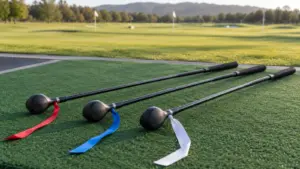
- Overspeed systems use differently weighted clubs and aim to train clubhead speed.
- Sensors and apps report data such as swing path or face angle instead of physical feel.
Choose feedback you can read right away. Prefer an aid that gives clear, immediate feedback and is hard to beat by cheating.
Check fit and practice setting. Confirm the aid suits your space, is portable and adjustable, and is simple enough to use every session.
Treat versatility as a bonus. Long life and extra uses add value, but they don’t justify an aid that misses your main problem.
Warm up and train both sides before any overspeed session. SuperSpeed’s protocol advises warming up first, training both dominant and non-dominant sides, and following the prescribed sequence rather than improvising.
Use the aid briefly, then test with a regular club. Remove the aid and hit with your own club to see whether you can make the movement alone. Motor-learning guidance recommends reducing reliance on the aid so you learn to detect the movement yourself.
Judge the aid over several weeks. Track whether repeated practice produces measurable progress on your problem, not whether one session felt good.
Match the aid to your practice goal
Start with the one swing problem you want to fix, then pick the aid type that acts on it. If the cause isn’t clear, an instructor, a video of your swing, or launch-monitor data can help you diagnose it. Choose an aid whose action directly targets the change you want, not one that promises you’ll hit longer or straighter.
Your intended focus tells you which type of aid to look at:
- Swing mechanics: Flexible-shaft, counterbalanced trainers such as the Orange Whip are designed to build feel for rhythm, tempo, balance, and sequencing. That is the manufacturer’s stated purpose, not independent proof of results.
- Tempo: Electronic tempo trainers use timed lights, sounds, or vibration to cue swing phases. The TEMPO wristband signals when to start the backswing and when to start the downswing.
- Clubhead speed: Overspeed systems use differently weighted clubs for fast swings and are intended to train clubhead speed.
- Swing data: Swing-analysis sensors and apps report metrics such as tempo, speed, swing path, or face angle, so they suit you if you need numbers rather than physical feel.
An aid you can easily game won’t show whether your swing is changing.
A device on its own doesn’t guarantee improvement; it only gives you targeted feedback. Pick one aid, set a specific practice target, and check after several weeks whether the swing change you wanted has shown up.
Check fit, feedback, and practice use
Check every aid against three things: the feedback it gives, how you’ll use it, and whether it fits your routine.
- Feedback source: Physical aids cue feel, while sensors and apps report numbers such as tempo, speed, swing path, or face angle. Pick the type that matches the problem you identified.
- Practice setting: Confirm the aid suits where you practice, and favor one that’s portable and adjustable.
- Simplicity: Choose an aid you can use the same way every session.
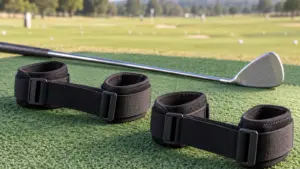
Electronic tempo trainers work through timed cues. With the TEMPO wristband, you wear the unit on your glove hand, press the swing button before each swing, and follow its countdown and vibration cues. Confirm the control positions for your model in its manual before your first session.
Overspeed training demands more setup care. SuperSpeed’s 2021 protocol handbook says to warm up before training, work both your dominant and non-dominant sides, and follow the prescribed sequence instead of improvising a high-speed session.
There is no published evidence for a generally effective training frequency or a guaranteed distance gain, so track your own results against the model’s protocol.
Note
The speed-stick study with 13 skilled male golfers measured only the acute warm-up effect, not long-term training gains.
Compare training aids by what they help you practice
Each aid type targets a different part of your swing, so match the practice focus to your problem before you compare feedback types. The sources support five categories, and only one of them reports a study size.
| Aid category | Practice focus | Feedback it gives | Golfers in study |
|---|---|---|---|
| Flexible-shaft, counterbalanced swing trainer | Rhythm, tempo, balance, sequencing | Physical feel | — |
| Electronic tempo trainer | When to start the backswing and downswing | Timed lights, sounds, or vibration | — |
| Overspeed system | Clubhead speed | Differently weighted clubs | — |
| Speed stick | Short-term warm-up effect | — | 13 |
| Swing-analysis sensor or app | Tempo, speed, swing path, face angle | Data metrics | — |
If your problem is timing, an electronic tempo trainer fits best because it cues each swing phase. If your goal is clubhead speed, an overspeed system is built for that purpose. Choose a data device only when you need numbers like face angle or swing path.
A separate study of two commercial swing aids found that neither significantly outperformed a standard club after 10 weeks. Pick the category that matches your focus, then track your own results over several weeks.
Frequently Asked Questions
Can a golf training aid replace a lesson with a pro?
No, an aid works best alongside a pro, because the cause of your problem may not be clear.
How much should a golf training aid cost?
Set your budget around the one problem you’re solving, then compare models that act on it. Versatility adds value only when the aid also targets your main problem. Check fit with your practice space and whether it’s portable and adjustable before you buy.
How often should I use a golf training aid each week?
No weekly number is established for every golfer, so judge your schedule by whether your swing change shows up over several weeks.
Are overspeed training systems safe for beginners or older golfers?
There is no published safety evidence for beginners or older golfers, so start conservatively. Beginners and older golfers should start with the shortest sessions and stop if the movement breaks down.
Can I use a golf training aid during a round on the course?
No, keep it for practice sessions rather than a round, where you’re focused on your score. Swap back to your own club after a few reps to see whether the move holds without the aid. Once the change holds with your own club, you can take it onto the course.
Conclusion
If your problem is timing, start with an electronic tempo trainer. Your next step is one range session this week. Warm up, use the aid for a few minutes, then switch to your own club and note whether the change carries over. Write down what you hit so your next session starts from facts, not memory.
Sources
- jewlscholar.mtsu.edu (jewlscholar.mtsu.edu)
- pluggedingolf.com (pluggedingolf.com)
- What Makes a Good Golf Training Aid? – Plugged In Golf (pluggedingolf.com, 2015-06-24T06:00:47-05:00)
- tempo.golf (tempo.golf)
- train.superspeedgolf.com (train.superspeedgolf.com)
- garmin.com (garmin.com)
- mygolfspy.com (mygolfspy.com)
- budgetdust.org (budgetdust.org)
- orangewhipgolf.com (orangewhipgolf.com)
- research.brighton.ac.uk (research.brighton.ac.uk)