Practice Golf Balls vs Regular: What’s the Difference?
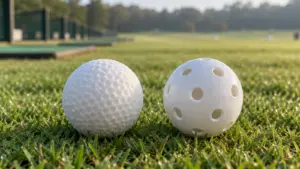
Practice golf balls vs regular depends on what the label means. Some balls marked “Practice” are regular balls with possible minor cosmetic blemishes, not reduced flight. A limited-flight practice ball is a different product: almostGOLF says its ball travels about one-third the distance of a regulation ball.
Choose the limited-flight type for a backyard or park, where you want to work on shot shape. Choose a regular ball, or a “Practice” ball with the same performance as current models, when practice should match play on the course. The mistake to avoid is buying on the word “Practice” alone, since that label can mean either type.
Key Takeaways
- About one-third of regulation distance is how far almostGOLF’s practice ball flies, so it can’t show real carry.
- Possible minor cosmetic blemishes, not reduced flight: TaylorMade says its “Practice” TP5 and TP5x match current-model performance.
- 1.620 oz (45.93 g) maximum weight for conforming balls, with a minimum diameter of 1.680 in (42.67 mm).
- About 10% less distance on launch monitors, due to a lower smash factor, according to almostGOLF.
- $69.99 for the Practice Pack, which includes 24 balls, a 36-inch target, a flagstick and a drawstring bag.
Quick Verdict: Choose by Practice Space
Start with the product type, not the label. A “practice golf ball” can mean a limited-flight training ball or a regular golf ball marked “Practice,” and these are different products. Limited-flight balls fit when your space limits how far you can hit. Regular balls fit when realistic regulation-ball performance matters to your practice.
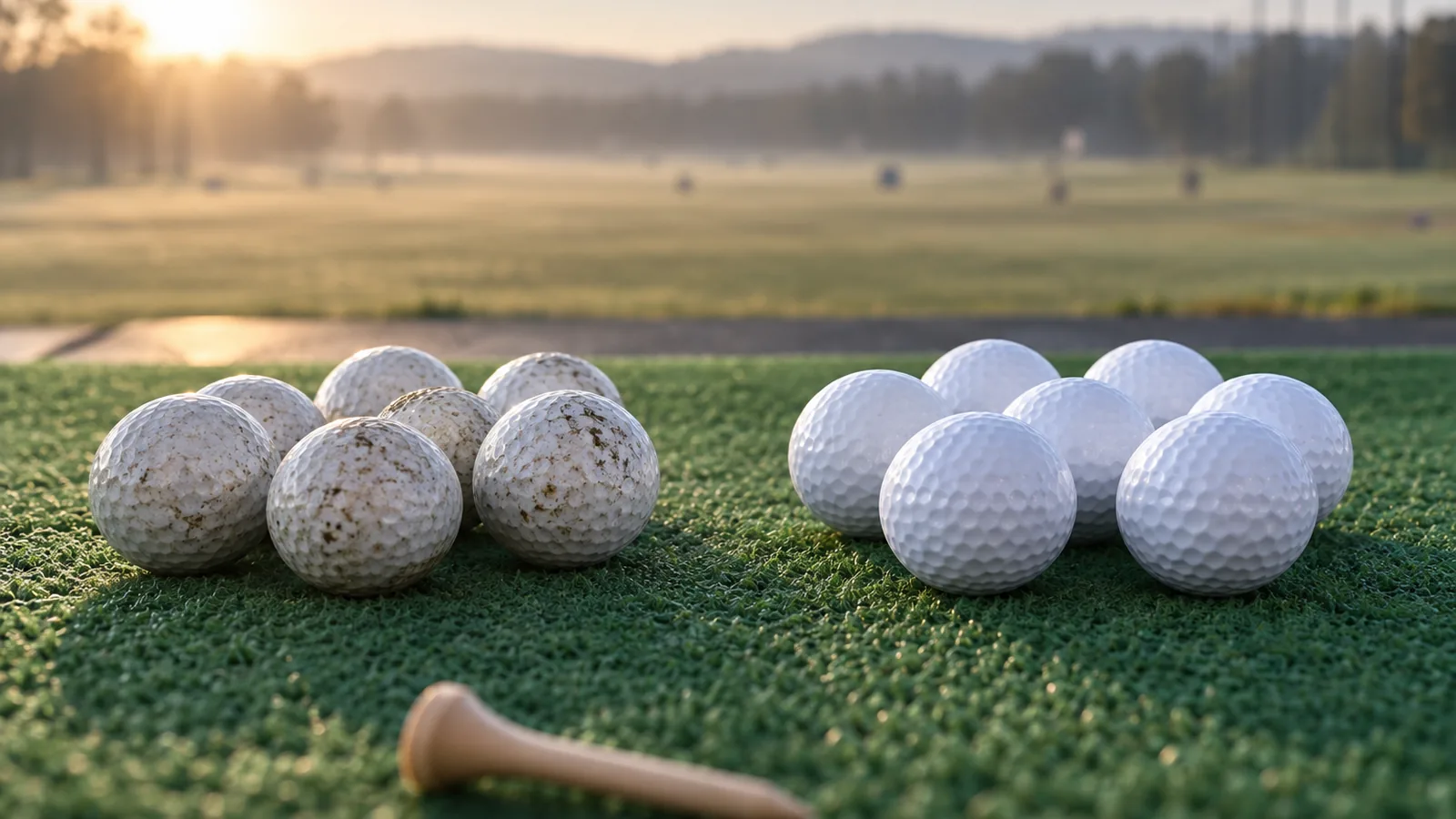
Read the marking before you buy. TaylorMade says its 2025 TP5 and TP5x “Practice” balls have the same performance and technology as the current models. The “Practice” label signals possible minor cosmetic blemishes, not reduced flight. A marked ball from that line suits you if you want current-model performance and can accept a cosmetic flaw.
Match the ball to your space and your goal:
- Backyard or small yard: Choose a limited-flight ball so your swing stays within a tight area.
- Park or school yard: Choose a limited-flight ball when you need shorter flight in a shared space.
- Practice that should match play: Choose a regular ball when you want your swing and feedback to resemble a round on the course.
If you have both kinds of space, you can keep one of each. Use limited-flight balls for tight-space work and regular balls for sessions where realistic flight matters most.
Practice Balls vs Regular Balls at a Glance
Practice balls come in two different builds. TaylorMade’s Practice ball keeps a five-layer construction, while almostGOLF’s is designed to fly much shorter.
| Ball | Flight distance (vs. regulation ball) | Intended use | Construction |
|---|---|---|---|
| almostGOLF CO₂ Pressure Tech Practice | About 1/3 | Indoor and outdoor practice | — |
It fits best in a backyard, a park, or an indoor room, where you care more about your swing than where the ball lands. The TaylorMade listing gives no flight or intended-use claims in the source, so read its full product details before you assume it flies like a regulation ball. Start with your space, since a tight area calls for a shorter flight, then match the ball to the goal you care about most.
How Construction and Specifications Differ
USGA rules cap a conforming ball’s weight and set a minimum diameter, but almostGOLF doesn’t publish either figure for its practice ball. Dimple count is the one spec you can compare side by side, and it doesn’t tell the whole story.
| Ball | Dimples |
|---|---|
| almostGOLF 10-Pack practice ball | 240 |
| Titleist Pro V1 | 388 (tetrahedral) |
Titleist attributes the Pro V1’s lower flight, compared with the Pro V1x, to its dimple pattern rather than the count alone. Compare pattern descriptions before you assume two balls fly alike.
Check weight and diameter first. Conforming balls can weigh up to 1.620 oz (45.93 g) and must be at least 1.680 in (42.67 mm) across. These are limits, not exact sizes for every ball, and almostGOLF doesn’t publish its figures, so you can’t check its ball against them.
If you want your practice to match regulation construction, pick a ball whose maker publishes its weight and diameter.
What Flight and Feedback Can Tell You
The almostGOLF ball shows shot shape, including straight shots, fades, and draws. Foam and wiffle balls, by comparison, fly unpredictably. If you’re working on shot shape, this ball gives you a clearer read.
almostGOLF also says its CO₂ Pressure Tech ball is soft enough for backyard practice and has limited-distance performance. That suits a small yard, a park, or a school yard, where full-distance shots need more room.
almostGOLF says its balls work with major launch monitors, including FlightScope, GC4, Garmin G10, SkyTrak, and Mevo+. On those systems, the company claims the ball returns:
- Ball speed, launch angle, and spin data
- Distance data
Distance readings run lower, too: the ball shows about 10% less distance than real balls, due to a lower smash factor.
Don’t apply that 10% to the separate distance claim for the limited-flight ball. Those figures describe different things, so combining them produces a conversion the sources never state. Use the 10% only to read the simulator’s numbers, not to estimate how far the ball would fly on a course.
Which Ball Fits Your Practice?
If you practice in a yard, park, or school yard, a limited-flight ball is the better fit. almostGOLF recommends its Practice Pack for those spaces and describes it as suitable for golfers of all ages and skill levels. The pack includes 24 yellow balls, a 36-inch inflatable target, a detachable flagstick, and a drawstring bag.
Choose a regular ball when you want to practice with the flight and feel of the ball you’ll play on the course. Titleist recommends the Pro V1 for players who may benefit from mid-trajectory flight, very low long-game spin, high short-game spin, and a softer feel. Mid-trajectory means the ball flies at a medium height. Very low long-game spin matters most when you’re working on full swings with your driver and irons.
If you want foam or plastic options, Franklin Sports lists a 12-pack of dense-foam balls and a separate 4-pack of plastic balls. Its listing gives no price or suggested practice setting, so check the product page before you buy. Treat these as a starting point, not a substitute for the ball you’ll play with.
Pick the setting first, then the ball. A backyard or park session points to a limited-flight pack, while a plan to build course-ready habits points to a regular ball.
Frequently Asked Questions
Can practice golf balls improve your swing?
almostGOLF says its limited-flight ball shows straight shots, fades, and draws, so you can see whether the ball curves the way you intend. The ball flies short, so it shows the result of your swing but not how a full swing carries. Pair it with regular balls for that.
Which is better for backyard practice: foam or plastic golf balls?
The plastic 4-pack’s listing gives no suggested setting, so check its product page before you buy. Foam and wiffle balls can fly unpredictably, which makes shot shape harder to read.
Are practice golf balls suitable for chipping?
Yes, for short chips in a small area, since a limited-flight ball flies about one-third as far as a regulation ball. For spin-sensitive chipping, use a premium regular ball that’s recommended for high short-game spin.
Will a launch monitor work with foam or plastic practice balls?
There’s no confirmation that foam or plastic balls work with launch monitors. almostGOLF’s practice balls work with major launch monitors and return ball speed, launch angle, and spin data.
Do practice golf balls wear out faster than regular balls?
Nothing points to faster wear. The “Practice” balls match TaylorMade’s current models in performance and technology. The marking flags only possible minor cosmetic blemishes. Confirm the cover and build details on each product page, since specifications vary by product.
Conclusion
If your practice space is a backyard, park, or school yard, pick a limited-flight ball so your swing stays inside the area you have. If you want practice that matches the ball you’ll use on the course, pick a regular ball, and if it carries a “Practice” label, confirm the only flaw is cosmetic. Before you buy, open the product page and look for flight claims and the weight and diameter specs. Then hit a few shots in your actual space to see whether the flight suits your goal.
Sources
- taylormadegolf.com (taylormadegolf.com)
- #1 Practice Golf Ball l Play Anywhere with almostGOLF (almostgolf.com)
- Practice Pack (almostgolf.com)
- usga.org (usga.org)
- usga.org (usga.org)
- JD | Indoor Practice (almostgolf.com)
- almostgolf.com (almostgolf.com)
- Shop Titleist Pro V1 Golf Balls (titleist.com)
- franklinsports.com (franklinsports.com)