How Thick Should a Golf Hitting Mat Be?
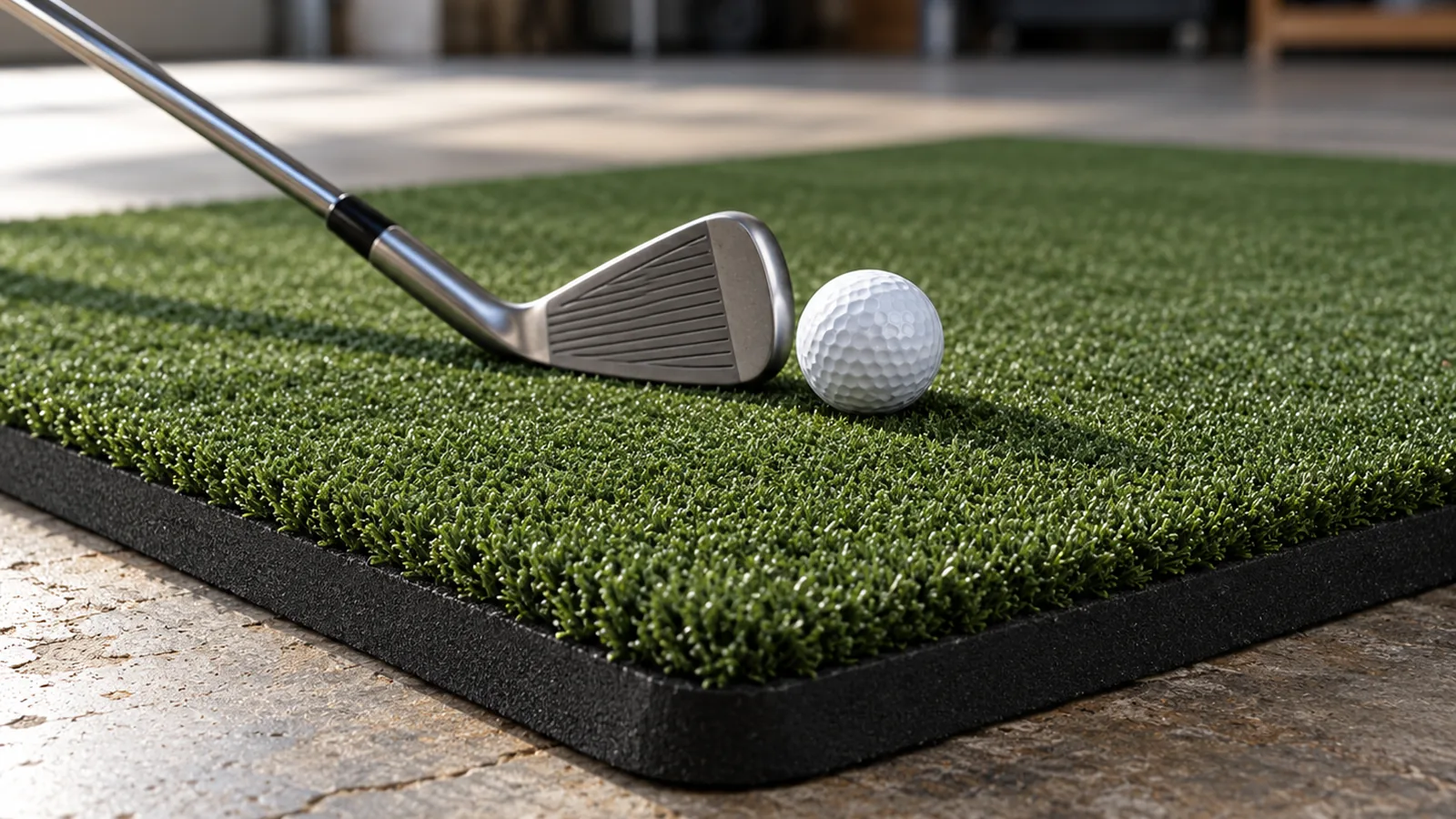
If you’re asking how thick should a golf hitting mat be, the common answer for home and indoor practice is 1 to 1⅝ inches total. Don’t compare thickness numbers across brands until you know whether a listing gives pile height, backing thickness, or overall height, because thickness alone doesn’t describe the playing surface or the impact-absorbing layers.
How thick should a golf hitting mat be?
Quick answer: For most home and indoor practice, aim for a total thickness of 1 to 1⅝ inches. That range is All Turf Mats’ commercial recommendation, not a universal standard. Go thinner, 3/8 to 1 inch with urethane backing, only when you need to move the mat or use it outdoors. Before you compare, confirm the listing gives overall thickness, since some listings give pile height or backing thickness instead.
- Home or indoor, stationary: 1 to 1⅝ inches total with foam backing for more cushioning.
- Portable or outdoor: 3/8 to 1 inch with urethane backing, which is lighter and easier to roll up, but gives no cushioning.
- Concrete or other hard floor: choose a mat with thick foam backing or shock-absorbing padding.
- Small hitting strip: add a separate stance mat so you can stand on a level surface.
How Is Golf Mat Thickness Measured?
A mat’s stated thickness can mean pile height, backing thickness, or overall height, and mat makers don’t share one standard method for measuring them.
Most listings combine some of these parts:
- Pile height: the height of the turf fibers above the backing, which sets the lie you simulate.
- Backing thickness: the foam or urethane layer under the turf.
- Overall thickness: the full height of the mat as the manufacturer states it.
Listings differ in which number they lead with. Some give only the turf pile height, which describes the hitting surface, while others give the total height of the whole mat. If a spec sheet names just one number, ask the seller which measurement it is before you assume.
When you compare two mats, match the measurement. Compare pile height with pile height and total thickness with total thickness. Don’t add the turf and backing yourself to estimate a total.
Five Star’s residential mat, for example, pairs 9/16-in polypropylene turf with 5/8-in shock-absorbing foam and lists 1¼ in (32 mm) overall. Use the listed total, since that’s the figure the maker publishes.
Note
Thickness figures don’t measure impact protection. ProSimHQ found that the manufacturer materials it reviewed didn’t publish impact-absorption results such as Gmax or ASTM test data.
Which Thickness Fits Your Practice Setup?
For most home and indoor practice, a total thickness of 1 to 1⅝ inches is the recommended range.
| Practice setup | Recommended total thickness | Backing |
|---|---|---|
| Home or indoor, stationary | 1 to 1⅝ in | Foam |
| Portable or outdoor | 3/8 to 1 in | Urethane |
| Residential build (example) | 1¼ in (32 mm) | Foam, 5/8 in |
Thickness and cushioning move together. Foam-backed mats give more cushioning for stationary indoor setups and long sessions, but they’re heavier and harder to move. If you hit often, stay in the foam range and lean toward the thicker end, because the 5/8-inch closed-cell foam provides the most cushioning of the options described.
A thinner urethane mat is lighter and easier to roll up, but urethane backing provides no cushioning at all. Choose it for a garage or outdoor spot where you move the mat around.
If your hitting strip is too small to stand on, add a separate stance mat. A single mat large enough for your feet and the hitting area can serve both roles.
Does Turf Type Change the Thickness You Need?
No, turf type doesn’t set a fixed thickness you need. Pile height, the turf fiber height above the backing, changes the lie you simulate, while the backing sets most of the cushioning.
Pile height by lie, from one manufacturer’s listing:
| Lie to simulate | Pile height |
|---|---|
| Tight fairway | 3/8 in |
| Tee box | 1 in |
| Rough or first-cut | 1–1⅞ in, variable |
Pick the pile height for the lie you want to practice, since that changes how the club meets the surface. Thickness then follows from the backing. Thicker foam-backed mats are heavier and harder to move, while thinner urethane-backed mats are lighter and roll more easily.
Thickness alone doesn’t tell you how a mat plays. The Pro Line Advantage mat is 1 in thick and simulates a fairway lie, while the Tee Strike mat is 1⅝ in overall, including 5/8 in of foam backing.
Impact also depends on design. One manufacturer’s Grass Series hitting surface is built to let the club hit down and through, and its rubber base adds cushioning.
Note
Pile height and backing figures come from one manufacturer’s listings, so compare the same measurement across products.
What Should Go Under a Hitting Mat?
On concrete or another hard surface, choose a mat with thick foam backing or shock-absorbing padding. Five Star recommends that setup but doesn’t name a required padding thickness, so you decide how much cushion to add.
The mat’s own backing does most of the cushioning. On All Turf Mats, the 5/8-in closed-cell foam backing gives the greatest cushioning, the 5-mm flexible foam gives moderate cushioning, and urethane backing gives none.
Your stance matters as much as the padding. A single mat big enough for both your feet and the hitting area can double as a stance mat. Add a separate stance mat when the hitting strip is too small to stand on, or when it must sit level with the floor around it.
Some mats build cushion into the base. Fiberbuilt says its Grass Series rubber base adds cushioning under the hitting surface.
Note
Frequently Asked Questions
Can you use a golf hitting mat on concrete?
Yes, you can, but choose a mat with thick foam backing or shock-absorbing padding underneath. Concrete is hard, so the backing does the cushioning, and urethane backing provides none. Check the backing type in the listing before you buy.
How do you keep a golf hitting mat from sliding?
Lay the mat flat and smooth out any curled edges before you hit, since a loose edge can shift under a swing. Set it on a dry, flat floor, and add a separate stance mat if the hitting strip is too small to stand on. Check the spot after each session and reposition the mat when it moves.
Does mat thickness change how far the ball travels?
No, thickness on its own doesn’t set ball distance: it mainly changes cushioning and weight. Pile height sets the lie you simulate, and impact also depends on the mat’s design. Compare the surface you hit from, not just the total height.
Can a golf hitting mat be too thick for home use?
Yes, it can be if you can’t move it easily or it doesn’t fit your space. For most home practice, 1 to 1⅝ inches total is the recommended range.
How do you clean a golf hitting mat?
Start by brushing the turf with a stiff broom to lift dirt out of the fibers. Rinse off loose debris with a garden hose, then let the mat dry fully before you set it back down. Skip harsh cleaners and check the maker’s care instructions first.
Conclusion
If you hit from a fixed spot indoors or at home, choose a foam-backed mat with a total thickness in the range given above. If you move the mat to a garage or yard, choose a thinner urethane mat and accept that it gives no cushioning.
Then measure the spot where you’ll stand and hit, and check that the mat covers both. If the seller can’t say how it measured thickness, ask before you buy.
Sources
- How Thick Should a Golf Mat Be? Pile Height and Backing Explained (allturfmats.com, 2026-07-07T10:29:17-04:00)
- fivestargolfmats.com (fivestargolfmats.com)
- elitesimgolf.com (elitesimgolf.com)
- fivestargolfmats.com (fivestargolfmats.com)
- prosimhq.com (prosimhq.com)
- siteone.com (siteone.com)
- synlawngolf.com (synlawngolf.com)
- fiberbuiltgolf.com (fiberbuiltgolf.com)