How to Choose a Golf Hitting Mat for Your Practice
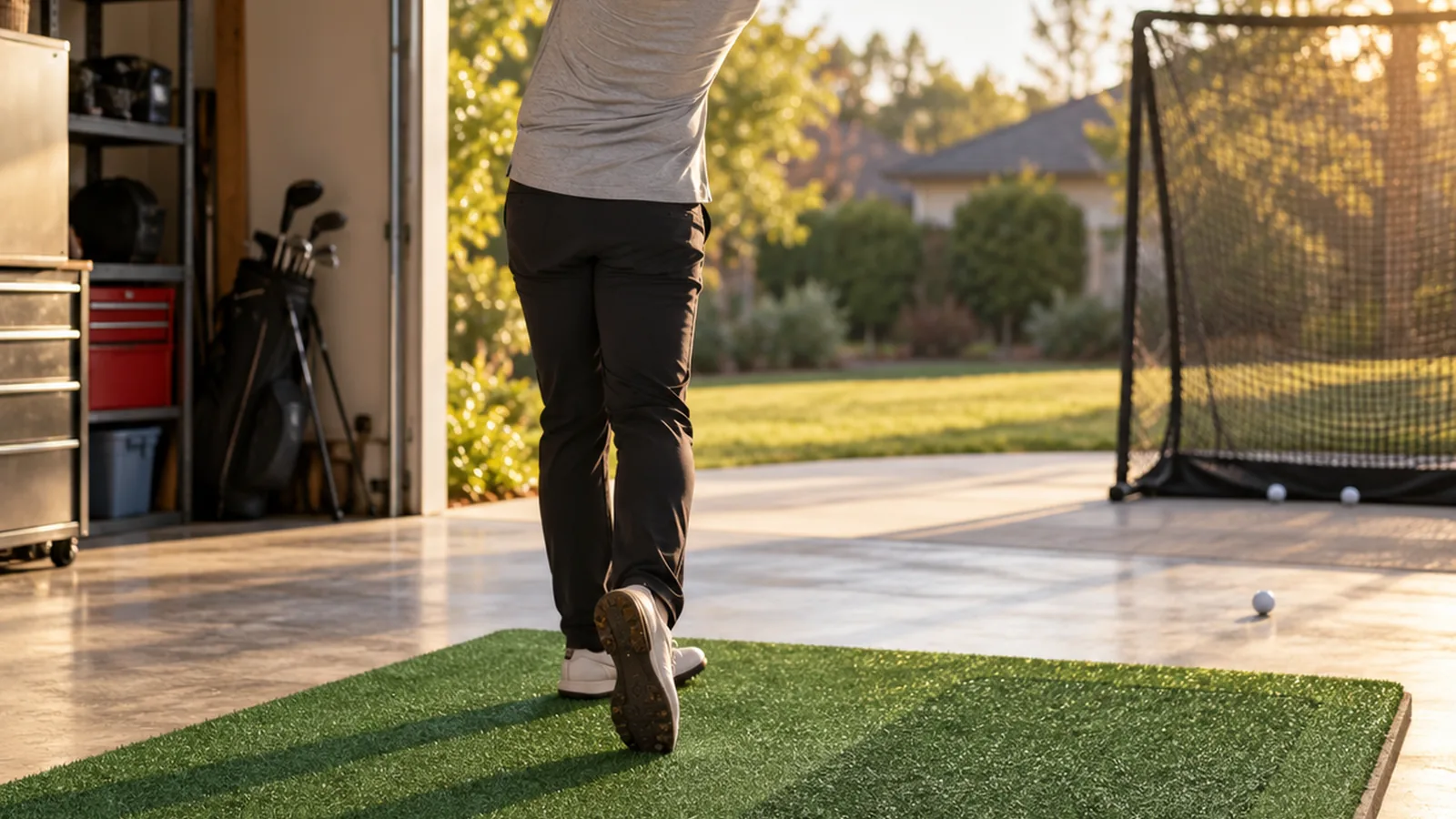
Learning how to choose a golf hitting mat starts with measuring the floor where it will sit, and Austad’s recommends at least 4 × 5 ft for a home simulator so you can stand level with the ball. Skip compact drill strips for full swings, since they may have no stance space.
Quick answer
How do I choose a golf hitting mat?
Start with the space. A home simulator needs at least 4 × 5 ft so you can stand level with the ball, though that’s retailer guidance rather than a universal standard. Then pick a thick base with soft, dense fibers, because a hard mat can make a fat shot bounce and seem better struck than it was. If you hit full swings, skip compact strips or drill mats, since they may have no stance space.
- Size: Measure at least 4 × 5 ft of floor for a simulator setup.
- Shared use: A 4 × 9 ft mat may accommodate right- and left-handed players.
- Surface: Look for a thick base with soft, dense fibers that absorb impact.
- Stability: Place the mat on a firm, level surface, and add a rubber base or double-sided carpet tape underneath if it shifts.
- Footwear: Wear spikeless golf or athletic shoes, since hard plastic spikes and metal cleats can damage the surface.
How to Choose a Golf Hitting Mat Step by Step
Work through six steps in order: measure the space, define how you’ll use the mat, compare surface and base, check fit with your setup, assess durability, then weigh cost against use.
Measure the practice area first. Hitting mat footprints vary, from an 8 × 16 in drill mat to setups of 4 × 5 ft, 7 × 4 ft, and 10 × 4 ft. Measure the floor where the mat will sit, including room for your stance and backswing.
Define the intended use. For a home simulator, plan on at least 4 × 5 ft so you can stand level with the ball. A compact hitting strip or drill mat may have no stance space, so skip it for full swings. A 4 × 9 ft mat gives more room and can accommodate right- and left-handed players.
Pick a thick base with soft, dense fibers. This combination absorbs impact and gives clearer feedback from the club face. Avoid a hard mat, because it can make a fat shot bounce and seem better struck than it was.
Note
This guidance comes from retailers, not a universal standard, and no controlled evidence shows that a mat surface prevents injury or reproduces grass exactly.
Check the fit with your hitting setup. Place the mat on a firm, level surface. If it shifts, add a rubber base or double-sided carpet tape underneath. Wear clean, spikeless golf or athletic shoes, because hard plastic spikes and metal cleats can damage the surface. If you use a simulator, check whether the hitting insert is separate and replaceable, since some mats use one.
Assess durability and care. Expect normal wear and compression, sometimes after the first few shots. Rotate your hitting position or the mat itself to spread wear across the surface.
Compare cost against expected use. Match the price to how often you’ll hit. A mat for frequent simulator sessions needs a stance area and more durability than one for occasional drills, so pay for the features your use actually requires.
Match Mat Size and Surface to Your Practice
Match the mat’s size to your space and the shots you plan to hit, then choose a surface that gives you useful feedback. Hitting-mat footprints vary by use instead of following one standard, from an 8 × 16 in drill mat to 4 × 5 ft and 10 × 4 ft setups.
If you hit into a simulator, one retailer’s guidance suggests at least 4 × 5 ft so you can stand level with the ball.
If you share the mat with a left-handed golfer, a 4 × 9 ft mat gives more room and may accommodate both right- and left-handed players. Listed sizes for popular mats:
| Mat | Listed size | Backing or thickness |
|---|---|---|
| Callaway Strike Zone | 8 × 16 in | Shock-absorbing rubber backing |
| ProActive Sports F4 Dual Surface | 1 × 2 ft | — |
| Fiberbuilt Grass Series Studio | 7 × 4 ft single, 10 × 4 ft double | — |
| Fiberbuilt Player Preferred Series Studio | 8 × 4 ft | — |
For the surface, look for a thick, forgiving base with soft, dense fibers. That construction absorbs impact and gives you club-surface feedback.
Check the Base, Durability, and Setup
Check stability, base and surface construction, wear, and fit with your clubs and stance before you buy. Start with stability. A mat that slides while you swing wastes practice time, so set it on a firm, level surface.
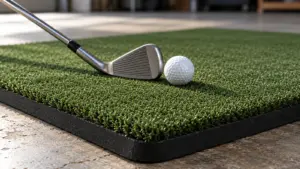
A non-slip rug pad also works. A heavy mat with rubber backing may stay in place without either fix. Callaway’s Strike Zone mat, for example, has shock-absorbing rubber backing and stitched edges.
Next, look at the base and fibers. Hard, low-quality mats can also scuff your clubs, and cheaper surfaces may mat down or leave green residue on the club bottoms.
Judge a mat by how well it stays put, how it feels at impact, and how well it holds up to repeated hits.
Last, check the fit with your setup. A stance mat matters for a home simulator, where you should stand on the same level surface as the ball. Measure the spot where you’ll stand, not just the hitting area, before you order.
Compare Golf Mat Features at a Glance
Footprints in the sources range from an 8 × 16 in drill mat to a 10 × 4 ft double-hitting setup, so size decides what you can practice. The table lists each mat’s stated size, use, and backing, with feet converted to inches.
| Mat | Footprint (in) | Use or setup | Backing | Source |
|---|---|---|---|---|
| Callaway Strike Zone (2026) | 8 × 16 | Indoor and outdoor | Shock-absorbing rubber | prodpwa.callawaygolf.com |
| ProActive Sports F4 Dual Surface | 12 × 24 | Dual surface | — | austads.com |
| Fiberbuilt Grass Series Studio | 84 × 48 | Single-hitting | — | austads.com |
| Fiberbuilt Grass Series Studio | 120 × 48 | Double-hitting | — | austads.com |
| Fiberbuilt Player Preferred Series Studio | 96 × 48 | Single-hitting | — | austads.com |
The Strike Zone is also the only mat described for both indoor and outdoor use, and its maker recommends soft foam practice balls indoors.
The 8 × 16 in strip is too small for that use. The double-hitting Grass Series Studio adds 36 in of length over the single version, so pick the single if your space is tight.
Frequently Asked Questions
Can you hit irons off a golf mat without damaging your clubs?
Yes, you can, but the surface decides how much wear your clubs take. Choose a thick base with soft, dense fibers, and wipe the club soles after each session.
How long does a golf hitting mat usually last?
Your practice volume and how you care for the mat both affect how long it lasts. Rotate your hitting position or the mat itself to spread the wear, and replace the mat once the surface stops giving you consistent feedback.
How do I clean a golf hitting mat?
Keep most of the cleaning to a minimum by stopping dirt and damage before they start. Wipe the club bottoms after each session, since cheaper surfaces can leave green residue on them.
Can I put a golf hitting mat on carpet?
Yes, but only if the carpet gives the mat a firm, level base. Carpet tape around the edges or a non-slip rug pad can also keep it in place.
Are replaceable hitting inserts worth it for simulator mats?
Yes, if you hit often on a simulator, because a swappable insert lets you renew the hitting surface without replacing the whole mat. Some simulator mats use a separate, replaceable insert, so check for one before you buy. A mat with a fixed surface gives you no swap option, so weigh that against how much you practice.
Conclusion
If you hit full swings into a simulator, pick a mat with room for your stance. If you only drill short, controlled shots, a compact strip can work. Before you order, mark the mat’s footprint on your floor with painter’s tape and take a few practice swings inside it. If your backswing reaches a wall or furniture, buy the next size up.
Sources
- austads.com (austads.com)
- Strike Zone Hitting Mat (prodpwa.callawaygolf.com)
- hubspot.carlofet.com (hubspot.carlofet.com)